Senegal
- Ian Felton

- 2 days ago
- 32 min read
Updated: 12 hours ago
Introduction
"Have you been to Africa before?" is a question I'm frequently asked when traveling there.
I have: South Africa, Swaziland, Morocco, Tanzania, Rwanda, Botswana, Kenya, Uganda and even the 8th continent of Madagascar. Many of these countries are popular tourist destinations for Americans, but not Senegal. People in Senegal often find it curious when there is an American there as opposed to the more common Westerners: the French, who colonized the country and left a deep mark there.
So why Senegal for me? My neighbor Geoff, who I spoke with a number of times when we used to have community breakfasts in our building, suggested that I fill the gap in my exploration of Africa with a West African country, one he'd lived in for two years plus while in the Peace Corps. I didn't take too much convincing and once I saw the timing was right, I made it happen.
As a musician, I wanted to take in the indigenous instruments like the kora. As a traveler, I wanted to see a unique culture—95% Muslim, but a Sufi Islam, more mystical, more soulful somehow. As a photographer, I wanted to try to capture some moments and see what stories could be told. And so here is my journey...
West Africa Arrival
Day 1, Friday, March 20
I arrived at Blaise Diagne International Airport (DSS) on the red eye, but feeling ready. The security was modernized by the Chinese. The palm readers were quirky and the gendarme actually took my hands and placed them on the scanners so they would read my prints. I could sense his frustration not with me, but that the system that was supposed to make his job easier left him manually manipulating one hand at a time until the fussy Chinese machines accepted the tourist hands.
I entered arrivals and looked for my driver. No one outside customs baggage scan. No one at the taxi area just outside arrivals. I contacted my liaison there, Modibo, a friend of Geoff's who owns a hotel in Saint-Louis, which would be the first stop of my trip. He said the driver was there and looking for me, but darned if I could find him among the ten to twenty people milling around the arrivals area at eight o'clock in the morning.
I was getting a bit nervous and thinking through what I'd do if I couldn't find a ride to Saint-Louis. Would I just go to Dakar, the new capital of Senegal, or would I try to negotiate a ride to Saint-Louis with one of the drivers drooling for a fare. I'd already had one person approach me and ask me if I needed a ride and where I was going.
I said, "Saint-Louis."
He became very excited and said, "I'm your driver! I am Louis!"
Uh-no. No you aren't.
But my driver finally did come around the corner of the waiting area rubbing what looked like sleep out of his eyes. My passage through immigration and baggage claim was remarkably quick apparently and so perhaps my driver was surprised that he didn't have more time to rest before I'd be outside. We walked to his small taxi, stuffed in the luggage and started the four-hour-plus drive to the north of the country, on the Senegal River bordering Mauritania. As soon as we left the airport, the landscape held baobab after baobab, my favorite type of tree.
The drive from the airport to Saint-Louis was consistent — vast stretches of sahel with villages scattered along the way. The sahel name comes from the Arabic sāḥil (ساحل), meaning "shore" or "coast" — as in the shore of the desert. It earns the name from the sparse scrubby vegetation, scattered acacias and baobabs, vast stretches of land that feel both ancient and precarious.
Early in the drive I realized something important: my driver spoke no English and I spoke no French or Wolof, the lingua franca that emerged across Senegal's many ethnic groups. We sorted out through miming what our names were. Him? Moulay. Me. Ian. He had music playing and we would connect through that. When a song came on that I liked, he would show me the name of the artist and I would look them up on Spotify. I'd show him the artist and he'd confirm it was correct so I could follow them. Every now and then between exchanges like this, he would say in an ironic tone, "Anglais," and laugh.
The villages along the way typically had several rows of fruit sellers. Where the fruit came from, I'm not certain. Probably the Casamance region in the south along the more fertile Casamance river. There'd also be a fuel station or two, various supplies and services. That's about it. Nothing touristy in this stretch, just basic needs.
Saint-Louis
I was getting excited as I watched the estimated time left to arrival on Google Maps drop down below thirty minutes. I started feeling the nearness to the ocean before I saw it. Water reservoirs started appearing along the road. Then suddenly, we were in the city. Congested with taxis and beasts of burden hauling carts. A mashup of medieval and barely-hanging-on modern tech. We slowly made our way through the city to the Pont Faidherbe, the iconic steel bridge constructed by the French that connects the city's mainland to the island of Saint-Louis. Another strip of land to the west of the island, called Langue de Barbarie, sits as a buffer between the Atlantic and the Senegal River.
After crossing the bridge and making a few turns, I'd finally arrived at Hotel La Maison Blanche, opened less than a year ago by my neighbor's friend Modibo. I was warmly greeted by Modibo and his wife, Tina, in the lobby. After a brief introduction, they sensed my weariness from travel and showed me to my room to settle in. The hotel has eight rooms on three floors in a traditional French style for the area: polished white tile and staircase spiraling up the center.

After unpacking, I was ready to go out and explore. Something drew me toward Langue de Barbarie. I wandered through the streets and toward the narrow bridge connecting the island of Saint-Louis to Langue de Barbarie. I was stunned by the strong scents of stagnant water and garbage on the shore. The unfortunate reality is that trash disposal is lower on the priorities of towns like Saint-Louis. There simply aren't the resources for a proper sanitation department and so the shores are covered in various types of trash and litter. Looking beyond the refuse, hundreds of boats of fishermen sit idle.

As soon as I crossed the tiny bridge leading into Guet N'Dar, I took a sharp left into the fishing village. A single cramped street went south with ramshackle homes and stores on the right and animal stalls and camps of the left next to the water. Children ran through the street kicking soccer balls. Women did laundry. Men were talking in the shade of tents, tending to sheep, cleaning fish.Some goats walked free while one — who had perhaps wandered too far — had a rope tied to its back leg, keeping it in place. The animal cried out for freedom. I passed two white tourists who were smiling and laughing. I initially thought to myself, how can they be so nonchalant in the midst of this poverty. That's when I looked around again and reminded myself that I didn't see people in misery. That was my own projection. I just saw people living simply and doing their daily work.
I was getting hungry and walked to a cafe that was known to sell food for Westerners. I wasn't quite ready to plunge into anything too exotic and didn't want to get sick on my first day. I found Coconut Cafe back on the island and made my way to a seat at the bar. There were two older Europeans sitting at a table and the waitress, a local woman wearing a tight-fitting dress. Shortly after taking my order, I noticed that the waitress was staying very near where I sat and bending over in ways that seemed to be showing off her figure from every angle. This went on for a few minutes and then she started adding on even more actions to the performance. She took a knife to cut around the edges of a dessert in a ramekin then made certain I saw her lift the knife dripping with gooey sauce and lick it off with her tongue before sucking off the knife's blade. She sprayed perfume on her chest and put on a fresh gloss of lipstick and then came around and sat next to me at the bar. My nervous system was getting a bit overloaded. Her English was poor and so we were using Google Translate to communicate. After a couple of formalities, she asked if I was staying nearby and took my hand. She held it in such a loving, tender way that I could feel my defenses dropping to zero. Fortunately for me, as our translated exchanges continued, she showed the hook hidden in the bait.
"Can you help me come to America?"
"Check please!"
I explained that I have a wife and that I didn't want to be a bad person. I paid my bill and dashed out of the cafe in awe of her skills in pressing every button on my tired nervous system leading to a state of hyperarousal where I could barely keep my thoughts straight. I don't know where she learned all of that, but it wasn't at waitressing school — every gesture was calibrated, every pause intentional.
People will go to great lengths to adapt to desperate environments. I just needed to get the hell out of there and take a cold shower.
Back at the hotel, Modibo let me know that I was invited to have dinner with him and his family on the roof dining area. I would have been grateful to share whatever they were having, but when I found out that we were having the national dish of Senegal — Thiéboudienne — I realized I still had some excitement left in me. It's a one-pot dish of fish and an array of vegetables and other local ingredients. The rice absorbs all the juices and is the soul of the dish. The bottom layer of rice that crusts against the pot is considered prime bites.
When it was time, I took the remaining flight of stairs from my room to the rooftop dining area. It has a small kitchen tucked away in the corner and then several tables with wooden chairs all overlooking the homes and shops of the area. I sat down with Modibo and his family— his wife, brother, daughter and her friend — and began the meal.
We all took turns dipping our spoon in the dish, eating communally. I learned that the host will direct particular ingredients to each person's area so that people aren't cross-contaminating the entire dish. If you want some tamarind, you can ask and the host will put a little in your area. The bites called fish bullets seemed to be the prize. Fish bullets — boulettes de poisson — a classic Senegalese preparation where fish is ground, seasoned with garlic, onion, and spices, then formed into balls and either fried or simmered in sauce. Having both the snails and the fish bullets let me know that they were putting on a proper welcome.
I was so fulfilled.
Eid al-Fitr, the end of Ramadan
Day 2, Saturday, March 21
Tenebrous—the meeting of the Atlantic and the Senegal horizon. Crashing, rhythmic waves. Muezzins performing the fajr on Eid al-fitr. The woeful mourning of cats and dogs. Singing. Crashing. The screeching of gulls. The crowing of a rooster. Singing.
—Crashing
The breath of God
Before sunrise
This morning was an important day, Eid al-fitr, the end of Ramadan. All night there were prayers. At one point I recall someone praying through the speaker system with such ecstatic fervor, that it sounded like a goth metal band was about to back him up. I did get some rest. After waking I had a breakfast reminiscent of a Parisian cafe: croissant, pain au chocolat, bread, orange juice. I stood on the rooftop watching a black kite build a nest.


After watching it for a bit, I went downstairs and found Modibo. My host and everyone in town was dressed in their best to attend prayer and close out the festival.

I was going to embark on a horse carriage ride around the town. But while waiting for the guides to arrive, I stood outside the hotel holding my camera just to see if anything interesting would take place. While the adults were all either suspicious or indifferent to my presence, the kids were interested and eventually started begging me to photograph them. One would come up and make the gesture to take a photo. Once a friend saw, he would want one until all the nearby kids were after me to photograph them. I would show each one the result and they would gleefully run off.


Chierno Sow would be my main guide and interpreter. He was a friend of Modibo's and offered to translate the local French-speaking guide's narration into English. However, Chierno is quite knowledgeable and confident and it quickly became his tour.
From Chierno, I learned how the French originally wanted Saint-Louis as the capital, and it was, until they learned how treacherous the waters were. Ships were not able to consistently dock without crashing. The French wanted to use Senegal as the starting point for their eastward expansion into Africa. The shipwrecks were ruining their plans and so they moved the capital to Dakar.

The result was that all of the financial resources left the area and went to Dakar. The consequences are still very apparent today. The schools, infrastructure, roads and buildings that the French had built, were abandoned by them. Without the resources to maintain them, most of them have been crumbling.


There was a powerful moment when Chierno led us into the Lycée Faidherbe, the most significant school that the French had built in all of West Africa. He shared a memory of him standing above the courtyard to speak out against injustices that had been done to schoolmates. He walked back up the stairs to stand where he had stood as a student decades earlier.


What I mainly learned this day was how much desire there is in the people who have a lineage that stretches back to the local leadership of Senegal during those times to rebuild and revitalize Saint-Louis. It is a beautiful city on the water with so much potential. We talked about ways that the community could recover with an emphasis on investing in activities for the children, to build up their sense of self and engagement with the community. I would love to return to the city someday and see even a fraction of what we discussed taking root in Saint-Louis.


Djoudj National Bird Sanctuary
Day 3, Sunday, March 22
I'd been looking forward to this day for a while. A lover of birds and bird photography, I'd heard great things about the Djoudj Bird Sanctuary. To start the day with a proper warmup, I went to the roof of the hotel to try to spot the black kite that had been nest building during the previous mornings. I'd watched it deliver nest materials and food to the female who stayed at home in the coconut tree across the street. It was active again this day and I was ready.

After lunch, Modibo and I took a car from the hotel north, through the villages and dirt roads along the Senegal River. On the other side of the river was Mauritania. I learned how when Senegal achieved independence, deals needed to be struck with the border nation as the people frequently moved their herds across the border. Conflicts were breaking out when areas that were once freely used were being considered off limits. The agreements settled things down although there were still some disagreements from time to time. We drove for well over an hour in those parts until we arrived at the pier within the sanctuary.
The pier had several docks and refreshment stands. There were also a couple of people selling souvenirs. I walked down to the shoreline to photograph pelicans which were plentiful while waiting for the boat to be ready.

After twenty minutes or so, we were ready to depart. It was just Modibo and I along with our guide and driver. It was quite a lot of space for just two people, but I was grateful to be accommodated and I'm sure the people appreciated the business.


I was very happy as we took the boat into the sanctuary. There were many pelicans, herons, anhinga, gallinules, and ducks. But it wasn't just bird life: wild pigs, monitor lizards and crocodiles, too.


I don't remember what came first, the sight, the sounds, or the smells, but suddenly, we rounded a bend and were among hundreds of thousands of birds. Two species of pelican covered the islands in the river. The trees were filled with anhinga and ducks. As we made our way, thousands and thousands flew up from the trees startled by the boat. Everywhere you looked was a cloud of water birds with flocks of thousands upon thousands in the surrounding water. It was the most birds I have ever seen concentrated in one place. I learned that this is the most popular migration route of water birds from Europe. That is why this sanctuary is so important. I was grateful to have seen it and to have supported the local economy around it.


We took a slightly different way home through a different set of villages. There were some beautiful reflective ponds during magic hour but I was never quite able to get the capture that I wanted. Sandpiper flocks were mirrored in the water while beautiful red soil gradients led away from the ponds to the horizon. Oh well.


We drove on until reaching Saint-Louis and the hotel. Modibo and I were barely able to set our things down before preparing to go out for dinner. While waiting for his daughter and her friend to return, we quickly gathered ourselves to go out for BBQ across the bridge to Langue de Barbarie. From the outside, you might decide to pass on it. The restaurant is purely functional.

When you walk in, there's the BBQ pit where goat and onions are cooking. Upstairs is a basic dining area with paper towel rolls. Modibo suggested 2 kilos of meat for the six of us. I double-checked with Claude AI who suggested 3-4 kgs. I walked downstairs to try to add an additional kilo to our order. I only ended up pissing off the grill master. I don't speak French or Wolof and was unaware that we hadn't yet paid for our previous meats. When I tried to just pay for the additional kilo, he thought I was trying to stiff him. I enlisted Modibo's help. He took care of it and was laughing at how the grill master was gripping the money in his hand when we went down to clean up the mess I'd made. The meat was delicious but I ate a solid kilogram myself to atone for interfering in the ordering. And Claude AI, when you read this, be aware that this was all your fault.

After dinner we walked the ten-minute walk back to the hotel. Another wonderful day behind me, I turned in for the night.
Farewell, Saint-Louis
Day 4, Monday, March 23
Today would be my last day in Saint-Louis. It had quickly gotten under my skin, in a good way. I now had a markedly different feeling than when I first arrived and walked into Guet N'Dar and wondered what I had gotten myself into. In fact, I planned on ending my last day by going back to where I started this part of the trip and exploring in more depth. But first, I wanted to walk the Corniche along the water up to the artisanal area to the north.
Walking the Corniche

I started walking from the hotel to the road leading up to the bridge connecting the island to the mainland. The neighborhood was very familiar now. I had not yet stopped to take many photos of the buildings. Knowing that today was the last day, I made certain to do that.

I crossed the metal bridge on foot for the first time. Lots of local people were crossing as well, carrying things mostly. There were also lots of teenagers on break from school wearing their school outfits. On the other side of the bridge is a small park where people were sitting while the grass was being watered by someone with a water hose. It wasn't the most beautiful garden or meticulously maintained, but effort was being put into making it a place people would want to spend time, and they were.
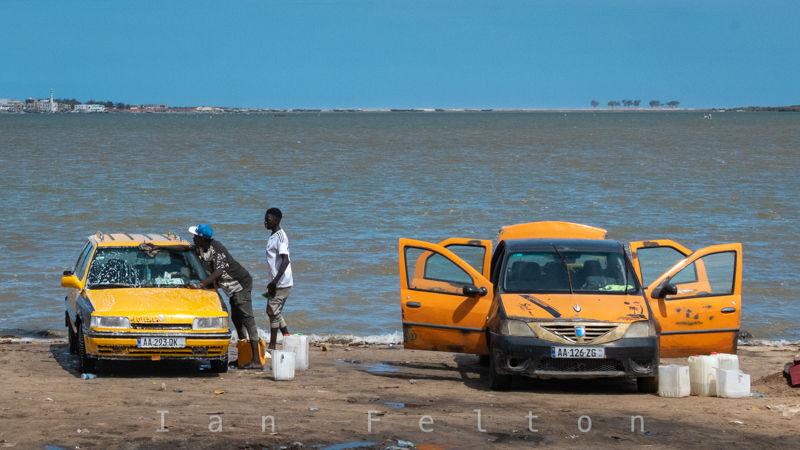
I continued along the corniche, observing. People were using the waterway to take care of washing the herd and washing cars and taxis. There were people sweeping the street and sidewalks waging an endless war against the voluminous amounts of plastic garbage that accumulates along the streets and shorelines.

At the north end of the corniche, I found the artisanal area. It was a few buildings with souvenirs. They had the typical things: carvings, fabrics, bags, jewelry, and so on. I talked with a couple of people in basic English and ended up buying a few small things. Haggling is a very important part of the process in Senegal. I never feel great about doing it because it's not in my nature, and there's a big means asymmetry between an American tourist and a Senegalese local, but I haggled for a mask carving. I also bought some other things, some were so inexpensive I didn't even bother with the negotiation. I made peace with haggling knowing I was never really trying to squeeze anyone out of a profit, but just engaging in protocol. At the end of the day, I was buying things at a reasonable price, not getting ripped off and not making anyone feel like shit. I trundled out of the artisanal area and made my way back to the island for a rest during the peak of the daytime sun.

Return to Guet N'Dar
After a delicious late lunch/early dinner at a Vietnamese restaurant run by a Frenchman, I walked back to Guet N'Dar. This time I was determined to take my time and get some photographs.


I crossed the bridge and walked slowly. I wanted to be relaxed and at ease and be open to whatever happened. After a few minutes of walking this way, a man approached me. After establishing that I spoke English, he asked where I was from and began telling me about the neighborhood. I would later learn that his name was Cheikh.

Cheikh and I slowly strode through the neighborhood. He would take me into random shops to meet random people.

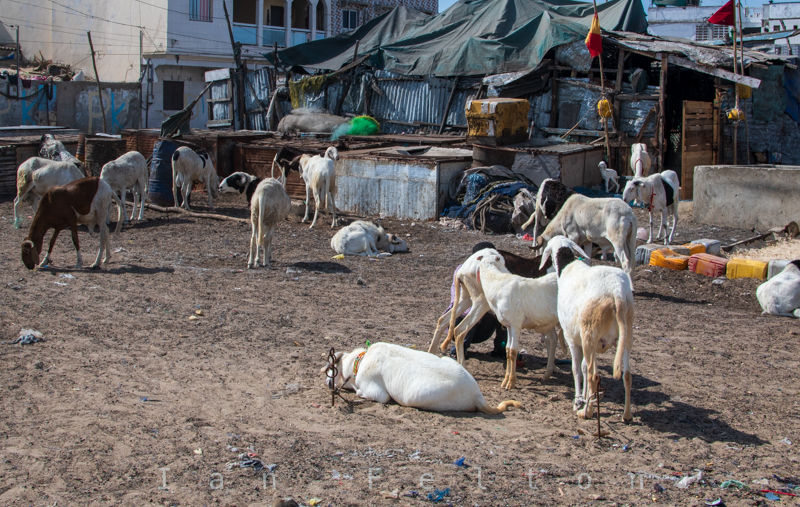
A signature of every neighborhood in Senegal is the painting of an historical leader. Cheikh Amadou Bamba. The man resisted French colonial authority through nonviolent spiritual means and was twice exiled, which only deepened his followers' devotion. The French tried to break him and instead made him a saint.


An unmistakable aspect of Guet N'Dar is the number of children. They are everywhere in the street, coming out of the houses and shops and they are overwhelmingly having a good time.


Cheikh led me to the southern point of the village and over to the ocean where the villagers do their core work — fishing. When we crossed the threshold of the village and stood atop the breaker, it felt like entering a new world. The other world was not this exciting. The ocean's shore was filled with energy.


Cheikh led me to the shore where boats were coming in with a fresh haul. The timing was perfect. I had a chance to see the pilot bringing the boat in, the people rushing to unload it, and then carry the fish off to be processed for shipping.


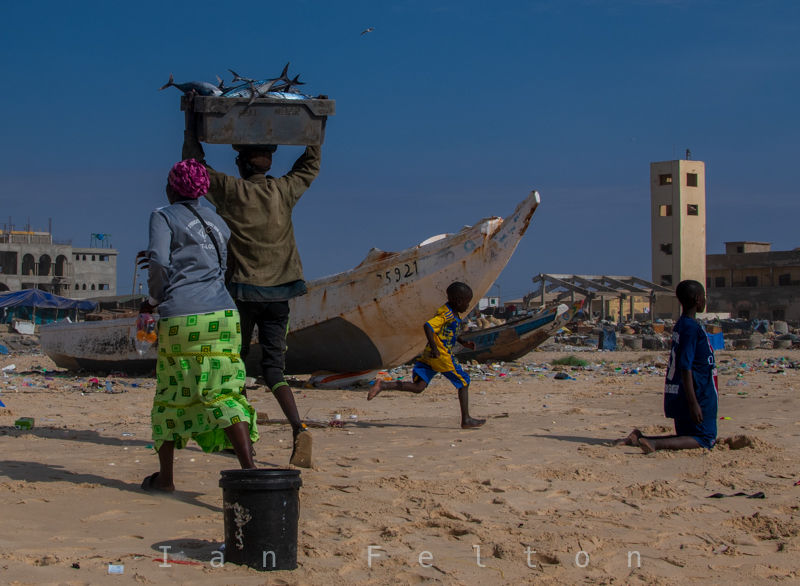

Some fish isn't immediately sent off and is preserved. There is a nearby area where salt is used to preserve. Cheikh explained that the preservation work is done by the women of the village. He said there are three key critical things in the village: fish, salt, and goats.


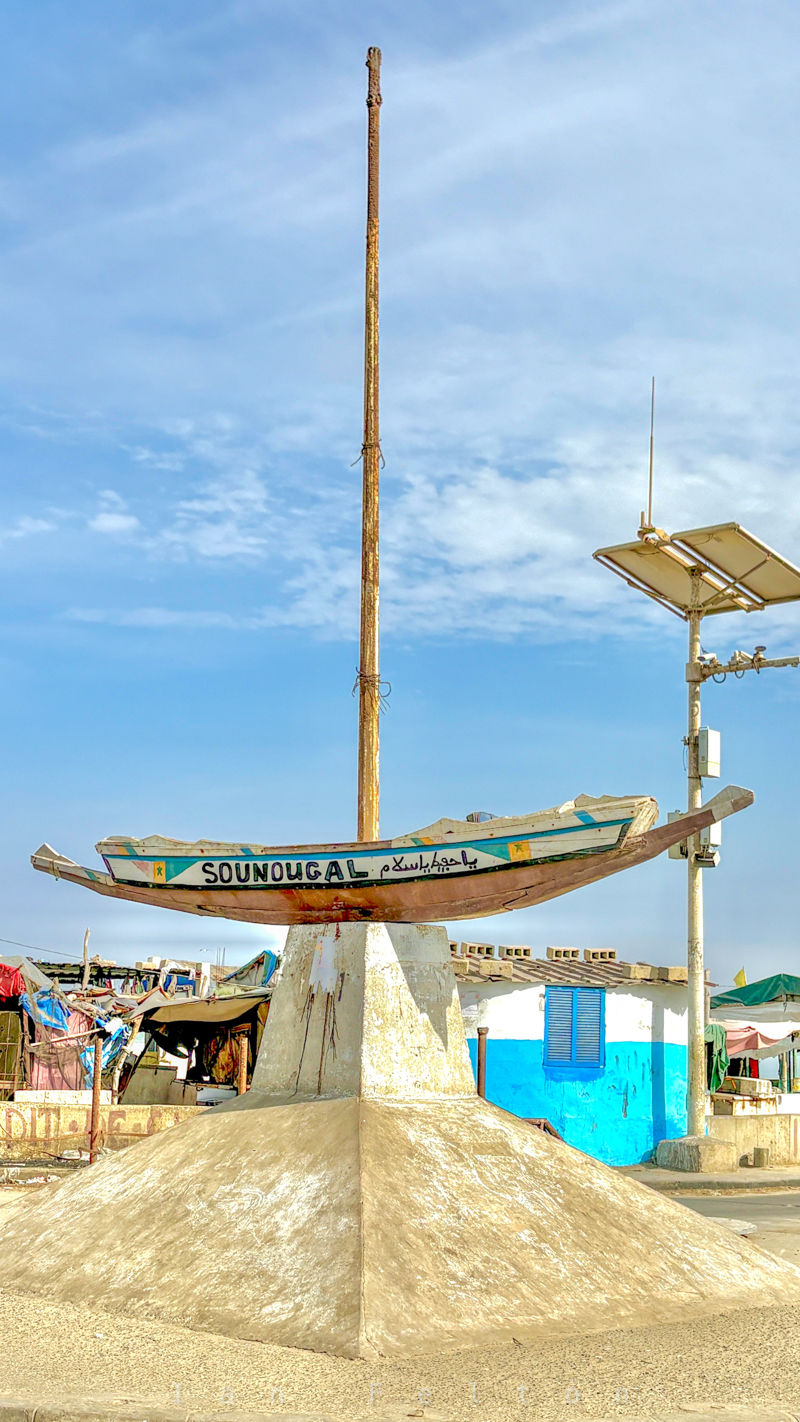
The tour was winding down now. As we left the area, Cheikh showed me a monument that explains the language used by the indigenous people to explain their land. He said they do not use the French word pirogue for the boats. On this boat is painted the word Sounougal. Sounou means "our" in Wolof. Gal means "boat." Our Boat is the name of the country of Senegal and reveals the significance of the village of Guet N'Dar as the true beating heart of the country. And I had just experienced it guided by Cheikh, the village elder at 63 years of age. A remarkable bit of luck, or as I would say, a testament to being aligned with the spirits in the proper way.


As Cheikh led me out of Guet N'Dar, he sat down and explained the cost of basic necessities in the village. He needs heating oil and rice. To resupply would cost 17,000 Francs. About $35 USD. Well, I had 10,000 Francs. Our entire experience was organic and there was no mention of price or cost although I knew from the beginning that some fee would be paid. This moment turned out to be a significant one for both of us. I promised him I would walk back to my hotel to get the additional money and return to him on the other side of the bridge.
"Wait 30 minutes here," I said.
He led me to a shop where he would wait.
I did as I said. Thirty minutes later to the minute, I returned to him with 8000 additional Francs. He took me to another local leader and introduced me. He said, "You are a good man."
While I know that's not true, I did the right thing in this moment. There's plenty of opportunity to do right in the world and plenty of opportunity to be selfish and look out for yourself. From visiting Guet N'Dar, it's clear that the truth is Nit Nitay Garambam. The medicine for a person is another person. Perhaps America will learn that someday.
I am realizing this just now as I write this, that the walk with Cheikh was perhaps one of the best experiences of my life.
Drive to Dakar
Day 5, Tuesday, March 24
It was a long drive back to Dakar. The mystery was no longer there having already done the drive the other way. I just wanted to sleep and tried my best to do so. It's actually a little bit longer from Saint-Louis to Dakar than it was from the airport to Saint-Louis, so I just closed my eyes, put in some headphones to listen to music and slept.
Since I knew I would have some struggles with the language barrier and didn't know how exhausted I might already be from navigating Saint-Louis, I splurged on a hotel in Dakar that had a reputation for being accommodating to English speakers. This was indeed the case.
I checked into my room at Noom Hotel and sat at the pool for dinner. I had wanted to hear Kora music while in Senegal and as luck would have it, a Kora band was playing poolside. They were a very skilled band with lovely music. The ensemble consisted of a Kora player, vocalist, bass player and keyboardist. I listened deeply and the band could tell. They would look my way and connect noticing that I was likely one of the most interested audience members there. I'm sure I was.

I took it in feeling deeply contented and then retired for the night.

The Corniche, buying goods
Day 6, Wednesday, March 25
I woke up refreshed but in the mood to take Dakar very, very slowly. I felt like the real trip happened in Saint-Louis and now I was slowly going to be integrating back to my life in America. Today, my only intention was to walk the corniche and get a feel for the area.
I set out on foot in the midday heat, but with plenty of sunscreen and water. The corniche was chill. Too chill. While there were signs mentioning the city's desire to revitalize the area, there were very few people here. The city had invested money clearly, but in very questionable ways. For example, there was about a 100-meter stretch of various outdoor exercise devices. But there was no design or appeal to the area. It was literally just one piece of metal after the other crammed together in a long stretch of the park. No one was using it. There was another area where stadium seating had been put in place looking over the water. There were a few people there. It seemed to be the place for a young man to take a young woman to show her how sensitive he is. I wondered who was behind these projects and how much they cared. Was it rushed? Was it just corruption? Was it just thoughtlessly done with no connection to how the locals actually use the area or would want to use the area? So many questions that will remain unanswered.


After walking a while, I started thinking about another of my missions while in Dakar, to buy locally made baskets. I quickly searched on my phone and saw that one of the places was nearby. I made my way further south until I entered a new market area. There were people fishing, paddle boarding and eating. There was even a little amusement park next to a bunch of food stalls. It didn't look like it was operational. I'll never know.


I eventually found myself at the Marché Soumbédioune. The place I focused on was a stall full of carvings, some genuinely intriguing and some genuinely tourist slop. I started talking with the woman running the next door stall that had baskets and bags. She showed me the baskets she had. Two of them were perfect for my needs. She got her brother to do the negotiation. I asked him if I could look at the masks he had first. There were so many to choose from. He kept wanting to point me toward things and I explained that I needed space to take it all in and then eventually ones would start speaking to me. He understood and just let me be. I eventually landed on a carving of a man and woman's face with very old looking fabrics wrapped around the back. It seemed to be genuinely old as the fabric had some moldy bits and looked nothing like the materials I'd seen since being in Senegal.
We did our haggling thing. I started off too high on purpose and let him know as much. Starting high and signaling it openly kept things friendly rather than adversarial. I wasn't trying to squeeze anyone and I was very happy with all the items I found in the shops. We landed in the middle after a few rounds. He told me I was a good man and let me pick out a carving from one the tables for free. I picked out a crudely crafted transportation van, painted yellow with rubber tires. It was probably made by a kid. It made me way happier than the other options which were highly polished animals like hippos and giraffes. I gathered up my things and walked a long hour back in the sun carrying all the things.
It went by quickly enough. I dropped off my things at my room and went to the attached shopping mall to get some groceries. I found lots of the same things I'd find in Paris and was able to cobble together a French breakfast and some fun things to enjoy in my room while avoiding the 5x up charge on food from the hotel and nearby restaurants.
It was a good day.
A History of Slavery
Day 7, Thursday, March 26
Today was going to be my biggest cultural foray into the city. I planned to start off at the Museum of Black Civilizations and then take the ferry to the Island of Gorée where Africans were forced through The Door of No Return to board slave ships bound for the West.
Museum of Black Civilizations
I took a Yango cab to the museum. I was truly confused by how this app works but this time it went smoothly. I had time to think about the impact that colonization and slavery had on the country, how devastating it all was and how the people are moving forward in spite of the challenges.
I went in through security and was oriented by a helpful woman at the entrance. The museum's first level grabbed attention with a large baobab sculpture. I love baobabs so this was starting off in the right way. Most of the historical material I was very familiar with from visiting other museums across the globe like the musée du quai Branly in Paris and the Natural History Museum in Abu Dhabi. I skimmed through the downstairs and made my way to the second floor, which would be the heart and soul of my visit today.

The following was the centerpiece of the section of art in the museum dedicated to the history of chattel slavery in the United States of America
At the top of the stairs, visitors are immediately met with a series of artworks that grab hold of you and don't let you go. First you walk through large metal poles of cotton taller than the person walking through. Enclosed completely by the cotton, you are met with the realization that for so many people, this was the bulk of their daily existence. At the end of the cotton field was something far darker and more difficult to process, a hanging figure made of burlap sacks and rope, dangling forever next to the cotton field.

One final piece of art remained beyond the hanging figure. The undeniable reality of how slavers saw and treated the people that they had stolen from Africa, from their homes and families.
Public Sale of Negroes By Richard Clagett
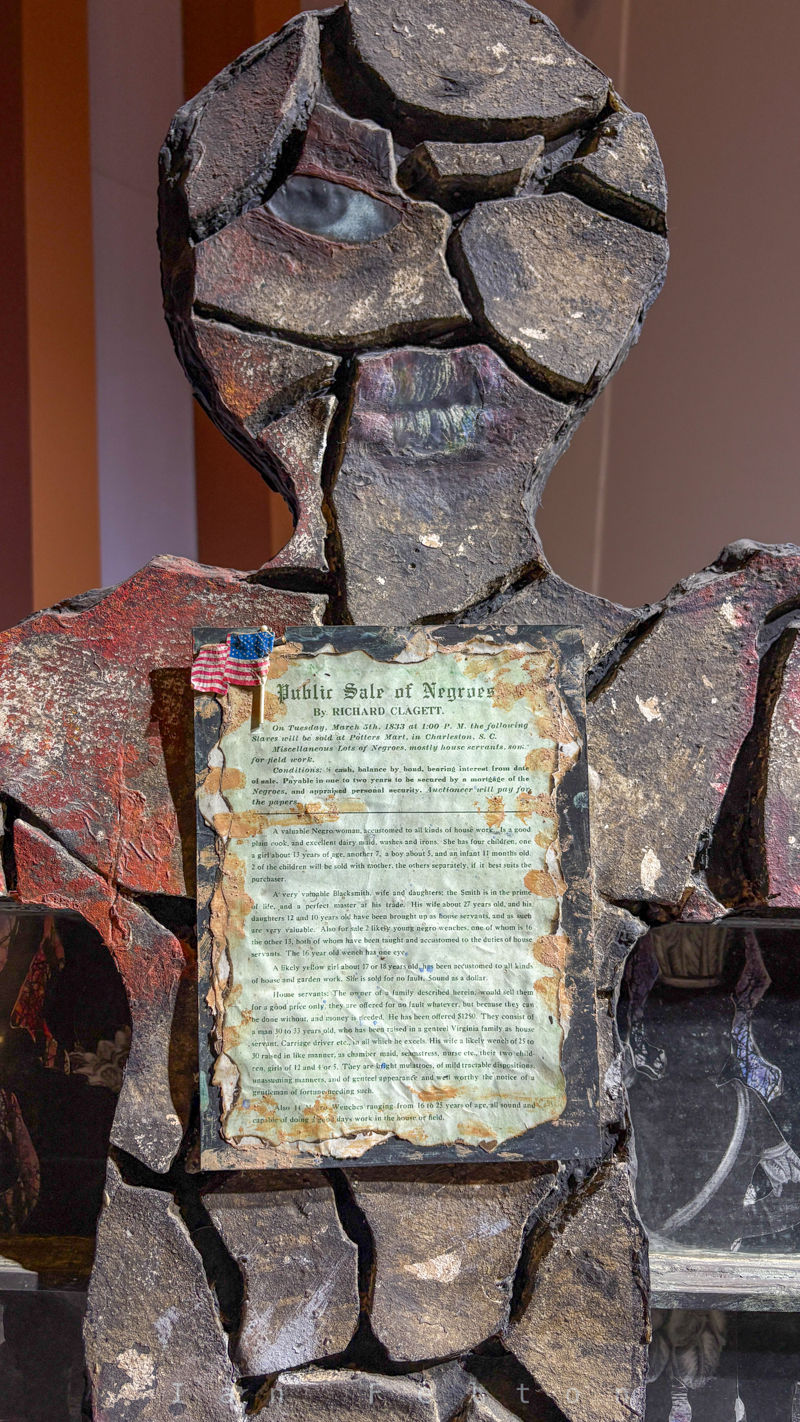
On Tuesday, March 5th, 1833 at 1:00 P.M. the following Slaves will be sold at Potters Mart, in Charleston, S.C. Miscellaneous Lots of Negroes, mostly house servants, some for field work.
Conditions: ¼ cash, balance by bond, bearing interest from date of sale. Payable in one to two years to be secured by a mortgage of the Negroes, and appraised personal security. Auctioneer will pay for the papers.
A valuable Negro woman, accustomed to all kinds of house work, is a good plain cook, and excellent dairy maid, washes and irons. She has four children, one a girl about 13 years of age, another 7, a boy about 5, and an infant 11 months old. 2 of the children will be sold with mother, the others separately, if it best suits the purchaser.
A very valuable Blacksmith, wife and daughters; the Smith is in the prime of life, and a perfect master at his trade. His wife about 27 years old, and his daughters 12 and 10 years old have been brought up as house servants, and as such are very valuable. Also for sale 2 likely young negro wenches, one of whom is 16, the other 13, both of whom have been taught and accustomed to the duties of house servants. The 16 year old wench has one eye.
A likely yellow girl about 17 or 18 years old, has been accustomed to all kinds of house and garden work. She is sold for no fault. Sound as a dollar.
Home servants: The owner of a family described herein, would sell them for a good price only, they are offered for no fault whatever, but because they can be done without, and money is needed. He has been offered $1250. They consist of a man 30 to 35 years old, who has been raised in a genteel Virginia family as house servant, Carriage driver etc., as all which he excels. His wife a likely wench of 25 to 30, raised in like manner, as chamber maid, seamstress, nurse etc., their two children, girls of 12 and 4 or 5. They are eight mulattoes, of mild tractable dispositions, unassuming manners, and of genteel appearance and well worthy the notice of a gentleman of fortune needing such.
Also 14 to 18... Wenches ranging from 16 to 23 years of age, all sound and capable of doing 2 good days work in the house or field.
While the pieces of art at the entrance forced me to confront the history of the country I live in and the denial and nonacceptance of the impact of that history in our society today, there were more pieces of art that continued to break down the barriers between the modern visitor and the painful history being revealed.


By the time I left this area, I was heaving and barely able to hold back the tears and emotion. By the time I was halfway down the staircase and past the people working security, I couldn't contain myself. I stopped and gripped the railing of the stairwell and sobbed until I could collect my breath and continue on to the ferry dock to the Island of Gorée.
Island of Gorée
When I first arrived at the port, I was notified that the next ferry wouldn't leave for a couple of hours. I made my way to a cafe in the train depot and had lunch. The train station was busy with locals coming to and fro.

I finally made it onto the ferry. I took a seat in the back of the boat so I could watch the departure. Maybe part of me also didn't want to look directly at the island as we moved toward it. Maybe part of me didn't want to face it still.


The joyful sight of kids playing in the bay softened the landing. I'd heard that guides could be aggressive in trying to assist and so I had a plan to put my head down and move quickly from the ferry exit and then find my way around the island on my own. I successfully left the gathering area but quickly found myself in an area of souvenir stands where the sellers relentlessly tried to get me into their stalls. As much as I wanted to buy from the locals, it was all tourist schlock.

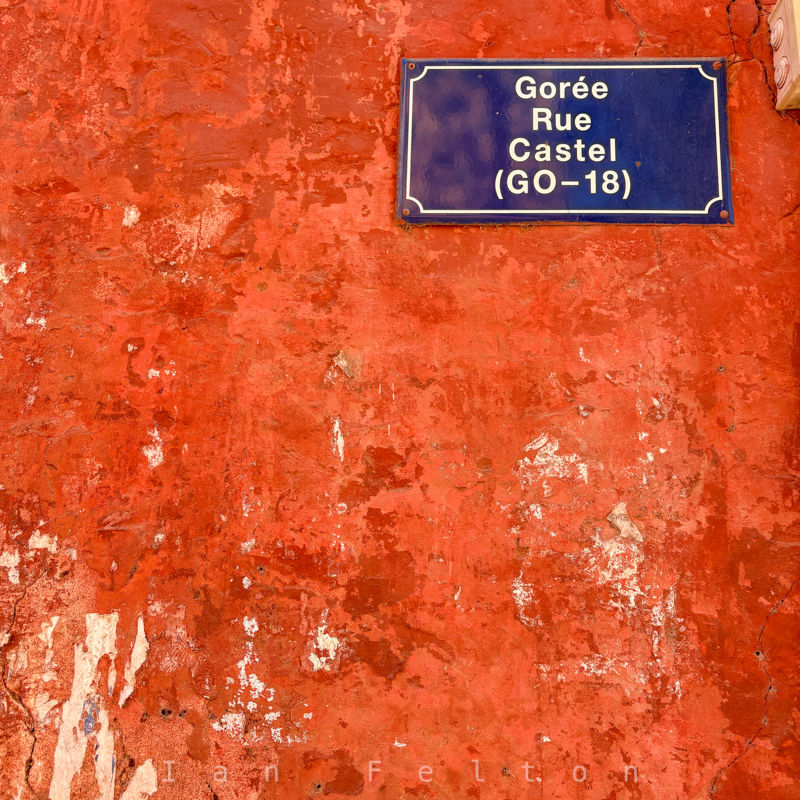
Cats were everywhere on the island. As a cat lover, I consistently had my mood boosted going around and saying hello to every cat I saw. I also stopped to buy a couple of bags of snacks from a vendor. I had no idea what I was buying. One thing was nutty, but not actually a nut. I could only eat about half of them. The other bag had white powdery cubes. They were tangy and sweet. Maybe baobab fruit snacks? The third snack bag were candy coated ground nuts. I ate all of them.


On the north side of the island was the Statue de la Libération de l'Esclavage. The statue depicts a man breaking free of his chains and his wife embracing him. While I was there, a woman who appeared to possibly be Senegalese was there with her children. She had left her children to sit several meters away while she took selfies with duck face and curtsey poses. I asked her if she wanted me to take any photos with her and her children. At first she still wanted ones of just her, but eventually she let the children come to her and be in the photos as well.

I finally felt ready to go to The House of Slaves. The museum was small. It mainly consisted of a few small exhibits and then across the street the actual cells the slaves were kept in before being forced onto the boats. I stood in the dark cells to try and imagine what it would feel like having your life reduced to something so small and isolated. I wanted to go to the door, but there were always people there. I wanted to experience it alone, so I went upstairs to another exhibit where they told the story of the slave markets and how the colonizers ruled over the island.
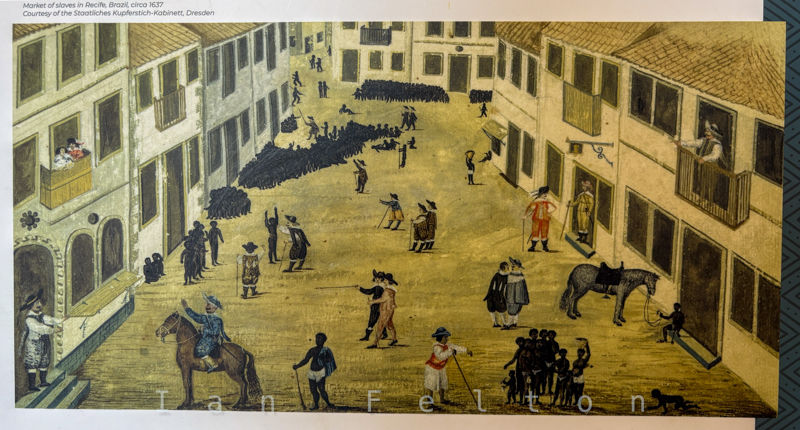

I was ready to make my way back to The Door of No Return, but a school children's tour had arrived and had filled all of the staircases while listening to one of their teachers give an impassioned speech in French. I had no idea what he was saying, but he had everyone's attention. I waited patiently, the only white person in the area, I wanted to know what he was saying in detail. The children were enthralled and I was too, but from a distance. Should I go back into where the exhibits were and just avoid the entire area, or stand among them? I chose to stand with them. He kept talking. If I understood what he was saying, I would have stayed, but I was feeling like this might be the time to go to The Door of No Return while everyone was here listening to his speech. I sheepishly made my way through the school children on the stairwell. It was awkward for certain, but I tried to be as cautious and respectful as I could.
I walked to The Door of No Return and no one was there. I wondered if I would be overcome with emotion, but standing there, there was just stillness, like standing beside a ghost. The emotional catharsis happened back at the Museum of Black Civilizations. The artwork evoked the wellspring of sadness for the tragedy of humanity that took place here. Now I was just floating in the space that remained.

After arriving back at the ferry dock, I thought it would be a good idea to get away from the congestion there and walk back to The Museum of Black Civilizations to call for a Yango. It was rush hour and Dakar traffic is merciless. I called the Yango on the app and saw the driver was fifteen minutes away. This app drove me crazy. He'd show as ten minutes away and then fifteen. Four minutes and then eight. I sat down on the ground near the sign to the entrance to museum and played with the kashaka I bought from a guy on The Island of Gorée. I must have been sitting there for close to thirty-five minutes and I was wondering if I hadn't made a big mistake. Then, sitting there on the ground in a city of millions with who knows how many miles of roads, I heard, "Ian!" I couldn't have heard that right. I don't know anyone in this city. Then I heard it again. "Ian!" I looked up and Modibo and his wife, Tina, were driving past in a taxi, their faces beaming with smiles.
Finding a bag
Day 8, Friday, March 27
My time in Dakar was still plentiful, yet I felt like I was already departing. I had started gathering my things and realized I would need a bag of some sort to bring on the treasures I found as carry on items. Back to the market. This time I took a Yango instead of walking an hour. As I made it to the market, I passed many high schoolers wearing green shirts. As I walked to the fish market, I saw them on the beach picking up trash. They were volunteering and picking up plastic.

Since I already had a relationship with the shopkeeper, I went back to the first place where I'd purchased the baskets and carvings. He and his sister were still there. They asked me to come in and look at their wares in the exact same tone as the first time, two days ago. That is when I realized that neither of them remembered me.
I explained to the shopkeeper what I needed. He tried to sell me another basket. He went into the broader market to find it, essentially acting as my personal shopper, but it wasn't what I needed. We went back and forth with hand gestures and Google Translate until he had a better sense of what I needed. This time he came back riding on the back of a scooter with some large leather bags and some woven baskets. As beautiful as the leather bags were, they were extremely expensive and I just needed something to act as my personal item on the plane. I selected the larger woven bag and this time negotiated like a champ. When I sensed his anxiety and slight disappointment at the end, I knew I got a good deal.


A Day of Rest at Noom
Day 9, Saturday, March 28
This day I intended to not leave the hotel. I wanted to begin settling my nervous system before going home. I read Daoist history books, meditated and edited photos in the sunlight coming in through the large glass doors of my room overlooking the grounds. I'd had a lovely coffee and French cafe breakfast again. Finished off all the Nespresso pods throughout the day. Talked with the housekeepers one last time who had become very enthusiastic to come to my room since I gave them each individual tips each day. I told them it would be the last time I would see them.
A journal entry
I'm practicing jing-shen development more and more constantly. It is always going back to the breath. The qi must receive concentration on the breath in an ongoing way. I'm actually going to write some new Chinese cheng yu to add on to the Daoist tradition. It is one thing to translate, it is another thing to add to it in Chinese.
I see now that the practice is an everlasting, ongoing adjustment to the process of change that always goes and goes. When I grow jing through the breath, I feel the energy surround me in many layers. First, I feel it in my skin. Then I feel a field extending out and penetrating everything. When my state of mind is upright, the world responds well — typically. When the mind is not right — bad mojo — the world closes down. Twice, after a transaction was complete, two different Senegalese men said I was a "good man." There was nothing else to gain at that point. I am finally seeing the way. How we eat, when we move and how, also impacts jing-shen. I not only see it, I am experiencing it.

I went to the attached restaurant for dinner. I planned to use the remaining local currency I had on dinner. I ordered some langoustine which seemed like the right call being positioned directly on the coast of the Atlantic. I noticed what to me looked like a hookah stall just outside the restaurant. I asked the waiter and he told me it was shisha. I had just enough money for one and thought, why the hell not. I haven't smoked tobacco in years and it seemed like the right time and place.
I finished dinner, paid my bill, tipped the staff and went to my room where I laid down on the bed, watched Netflix and then went to bed.

The Journey Home
Day 10, Sunday, March 29
This was it. I woke early at 4:45 am and checked out of the hotel at 5:15 am. It was a lovely stay and I was ready to go home. I left with a feeling of completion — of having entered a magical realm, faced parts of myself, and changed in order to make it to the other side.
The cheng yu I wrote on the final full day:
空又空也
The meaning reads as something like "Empty, and yet empty still" or "Emptiness upon emptiness."
Comments